
Treatments
Oils for Ayurvedic Massage: Which to Use and How to Choose
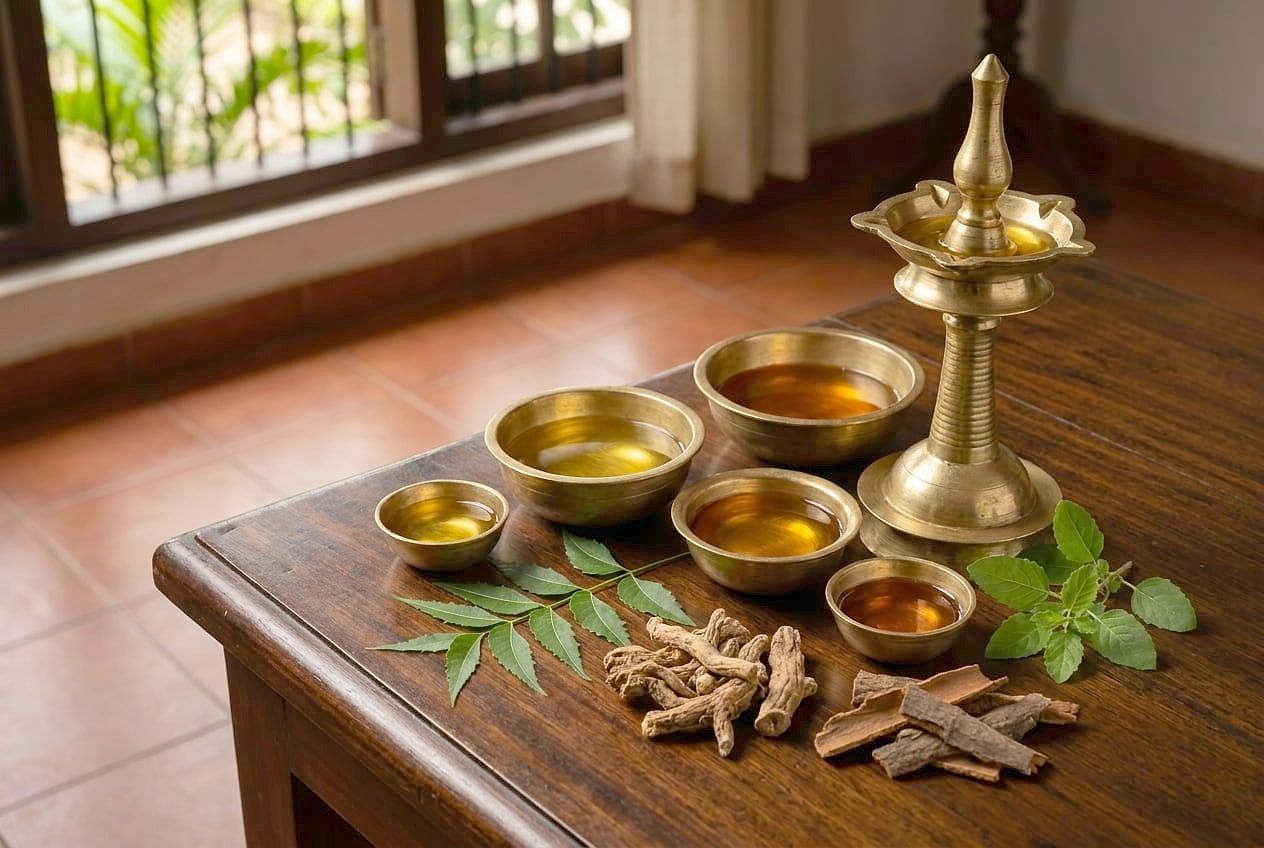
The main oil of ayurvedic massage is sesame. Coconut, mustard oil and ghee are chosen according to the person's state, and medicated oils cooked with herbs are prescribed by a doctor. How these oils are chosen, why they are warmed, how to store them and how to test an oil on your own skin.
Which oil is used for ayurvedic massage
The main oil of ayurvedic massage is sesame oil, tila taila in Sanskrit. The Charaka Samhita calls it the best of oils: it calms vata without increasing kapha. Coconut oil, mustard oil and ghee (clarified butter) are also used, and clinics mostly work with medicated oils cooked with herbs.
In ayurveda the oil is the active substance of the treatment, not a lubricant to help the hands glide. It is chosen not by its scent but for the person: by their constitution, their current state and the season. So one and the same oil for abhyanga, the ayurvedic oil massage, will not suit everyone. The treatment itself is described in the article on abhyanga, and the types of massage in Ayurvedic massage.
Oleation in ayurveda: what it is
Oleation is the usual English rendering of the Sanskrit snehana, from sneha — fat, but also attachment and tenderness. Ayurveda uses the word for everything that saturates the body with fat, from outside and from within. In the Charaka Samhita oleation is one of the six basic modes of treatment, alongside sudation, lightening and nourishing, and it has a chapter of its own.
The texts name four fats for oleation: ghee, plant oils, animal fat and bone marrow. Of these the Charaka Samhita considers ghee the best, and among plant oils, sesame.
- External oleation — oil on the skin: abhyanga, head and foot massage, pouring oil over the body — pizhichil. This also includes morning oiling, a short self-massage before bathing that the Charaka Samhita makes part of the daily routine; more in the article on dinacharya.
- Internal oleation — taking ghee or a medicated oil by mouth. This is a stage of preparation for panchakarma: the doctor sets the dose and changes it day by day, depending on how the person digested the previous one. It is never done on your own.
What follows is about oils for external oleation — for massage.
Base oils and the doshas
Vasant Lad’s school describes a simple rule: choose an oil with the opposite qualities. If you are cold and dry, you need a warm, heavy oil; if you run hot, a cooling one; if you feel heavy and sluggish, a light, warming oil, and not much of it. The classical texts give the same picture:
- Sesame. Warm, heavy, penetrating. The Charaka Samhita recommends it for dryness of the body and for vata conditions. The chapter on food adds that it is hot in action and can increase pitta, so it is used more carefully when there is a lot of heat.
- Coconut. Cool and heavy. Lad’s school names coconut and sunflower oil as suitable for pitta — heat, irritation, sensitive skin. With kapha it is not used much, because it is heavy.
- Mustard. The hottest of these oils. According to the Charaka Samhita it reduces kapha and vata but increases pitta. Lad’s school recommends light, warming oils such as mustard for kapha conditions — in small amounts.
- Ghee. The Charaka Samhita puts ghee first among the four fats and says it calms pitta and vata. In ayurveda ghee is more often taken internally, as prescribed by a doctor — for example during preparation for panchakarma — and is used externally in specific prescribed treatments. It is hardly ever used for an ordinary full-body massage.
The same logic of opposites applies to the season and the weather: cooling oils fit hot weather, warming ones fit cold and damp.
The amount of oil also depends on the person’s state. Lad’s school writes that for vata a lot of oil is used, for pitta a moderate amount, for kapha very little. What vata, pitta and kapha are is explained in the article on the doshas. Which of them are prominent in you, the online dosha test will show.
Medicated oils: tailas
In ayurvedic pharmacy a taila is an oil that has been slowly cooked with a decoction and a paste of herbs until the water has evaporated. The base is almost always sesame oil. These oils are chosen by a doctor: you cannot pick one by the name on the label.
- Mahanarayana. A multi-ingredient oil on a sesame base. It is traditionally prescribed when the main complaint is muscles and joints.
- Dhanwantharam. A complex oil from the Kerala tradition. It is often used for vata conditions and in restorative courses.
- Ksheerabala. A short formula: bala root, milk and sesame oil. A gentle oil, traditionally chosen for vata with signs of pitta.
- Pinda taila. Described in the Charaka Samhita: sesame oil with beeswax, manjistha (Indian madder), sarja resin and sariva. According to the text it is applied by massage.
We deliberately don’t list indications for specific diseases. A medicated oil is prescribed after an examination, not from a list.
Don’t try to cook a taila in your kitchen from an internet recipe. The process takes hours; the herbs, proportions and signs of readiness are set out in the classical rules of pharmacy, and a mistake changes the oil. Medicated oils are learned under the eye of people who make them all the time.
Oil for the head
In ayurveda the head is oiled separately from the body. Applying oil to the scalp is one of the daily practices of the classical daily routine, on a par with abhyanga: the texts recommend it for the sense organs and the hair. Next to it in the same routine are oil in the ears and drops in the nose, but these are separate practices with their own restrictions — see the article on dinacharya.
The oil for the head is the same as for the body: sesame as the base, and in a clinic more often a medicated oil cooked with herbs. For shirodhara — the treatment in which warm oil is poured onto the forehead in a continuous stream — ksheerabala or oils with brahmi and jatamansi are often chosen, and the doctor makes the choice. A short head, neck and shoulder massage is given both before dhara and on its own.
The rules for handling the oil are the same as for the body, plus a few of their own:
- Warm, not hot. Check the temperature on the back of your hand, just as before a body massage.
- In the direction of hair growth. The same anuloma rule that guides the strokes in abhyanga.
- Remove first, wash later. After the treatment the oil is wiped off the head and hair with a cloth, and a pinch of rasnadi churna, a herbal powder, is rubbed into the crown: it is believed to stop the oil on the head from causing a runny nose and heaviness. The head is washed later, and only with warm water.
- When oil is not applied to the head. With a blocked nose and sinuses, a runny nose, a productive cough or heaviness in the head; with wounds, rashes or infection of the scalp and forehead; with a fever or acute infection. The full list of restrictions is in the article on shirodhara.
How the oil is warmed, and why warm
Oil for ayurvedic massage is always warm. The reason lies in the logic of opposites: vata is cold, dry and mobile, while warm oil is warm, unctuous and heavy. There is a practical reason too: warm oil spreads more easily and the body relaxes under it, while cold oil makes you tense up.
- Water bath. Stand the bottle or bowl of oil in hot water for a few minutes. An open flame or microwave heats unevenly and can overheat the oil.
- Test on your skin. Check a drop of oil on the inside of your wrist: pleasantly warm, not hot.
- One portion at a time. Warm only as much as the treatment will use, and don’t pour the rest back into the bottle. In a spa oil left over from one client is never used for another.
How to store the oil
Plant oil oxidizes and goes rancid over time, and rancid oil is useless on the skin and can irritate it. A few simple rules extend its life:
- A dark glass bottle, tightly closed.
- A cool place out of the sun. Light and heat speed up spoilage.
- Clean hands and utensils. Don’t scoop oil out of a shared bottle with your hands.
- Check the smell. A rancid, sharp or unfamiliar smell means the oil should be thrown away.
Allergy, patch testing and when an oil is not suitable
Even a natural oil can cause a reaction: mustard oil is pungent and can irritate sensitive skin, and medicated tailas contain dozens of herbs. If someone is allergic to sesame, sesame oil and tailas based on it are not used without a doctor’s advice. Before using a new oil for the first time, do a patch test. The American Academy of Dermatology recommends applying a coin-sized amount to the inside of the forearm or the crook of the elbow twice a day for 7–10 days. Redness, itching, swelling or a rash mean you should not use the oil.
Oil massage is not given during a fever or acute infection, with indigestion or nausea, on inflamed or damaged skin, and in pregnancy only as prescribed by a doctor. The full breakdown is in the article on abhyanga.
Quality and safety
Sesame oil costs three to ten times more than ordinary vegetable oils, so it gets adulterated: diluted with soy, palm, cottonseed and other cheap oils. Choose unrefined cold-pressed oil from raw seeds, from a clear manufacturer, with the ingredients and best-before date on the label. Dark oil from toasted sesame is for cooking and is not suitable for massage.
Buy medicated tailas only ready-made from a manufacturer that lists the ingredients. Massage oils are for external use: do not drink them. Any oil or ghee taken internally for therapeutic purposes is prescribed only by a doctor. This article does not replace a consultation.
How this is taught
Choosing the oil is part of a therapist’s profession, not an add-on to massage. At the Ayurvedashala school, spa therapists, massage therapists and beauticians learn which oil is used for what, how to warm and check it, how to prepare a medicated oil with their own hands and when an oil treatment must not be given. More on the Ayurvedic massage for spa therapists page.
Sources
- Charaka Samhita, Sutra Sthana, chapter 13 'Sneha': the four kinds of fats, ghee and sesame oil (Charak Samhita Online)
- Charaka Samhita, Sutra Sthana, chapter 22 — the six modes of treatment, including oleation and sudation
- Charaka Samhita, Sutra Sthana, chapter 27, verses 286–294: properties of oils (English summary, Easy Ayurveda)
- The Ayurvedic Institute (Vasant Lad's school). Basis of Healing Principles in Ayurvedic Massage Therapy
- Charaka Samhita, Chikitsa Sthana, chapter 29 'Vatarakta': pinda taila, verse 123 (Charak Samhita Online)
- American Academy of Dermatology. How to test skin care products
Frequently asked questions
What is oleation in ayurveda?
It is the English term for the Sanskrit snehana — saturating the body with fat from outside and from within. Outside means oil massage and other oil treatments, including morning self-massage. Within means taking ghee or a medicated oil before cleansing; only a doctor prescribes and supervises that.
Which oil is best for abhyanga?
The base oil is sesame, which ayurveda considers the best of oils. At home you can do abhyanga with plain sesame oil. In a clinic the doctor more often chooses a medicated oil on a sesame base to suit the person's condition.
Can I use sunflower oil for ayurvedic massage?
Yes, if you are not allergic to it. Vasant Lad's school lists sunflower among the cooling oils suitable for pitta. In classical practice, though, sesame oil remains the base.
Is supermarket sesame oil suitable for massage?
Unrefined cold-pressed oil from raw seeds, from a clear manufacturer and with a best-before date, will do. The dark, fragrant oil from toasted sesame is for cooking and is not used for massage.
Can massage oil be taken internally?
No. Massage oils and medicated tailas are for external use. Any oil or ghee taken internally for therapeutic purposes is prescribed only by a doctor.
Message us
We reply personally, tell you more and help you choose the program and dates. The message is pre-filled — just press Send.
We usually reply within a few hours.