
Basics
Dinacharya: the Ayurvedic Daily Routine
Dinacharya is the daily routine that Ayurveda regards as the foundation of prevention. Behind the list of morning practices lies a simple logic: each time of day has its own qualities, and things are best done when the day supports them. Here is what the texts say and what still applies today.
What is dinacharya
Dinacharya translates as “daily routine”: “dina” means day, “charya” means conduct or way of acting. It is the branch of Ayurveda concerned with what a healthy person should do every day to stay healthy. It is about prevention, not treatment.
The main sources are the fifth chapter of the Charaka Samhita, which lists the daily practices, and Vagbhata’s texts — the Ashtanga Hridaya and the Ashtanga Sangraha. They describe waking, care of the mouth and sense organs, oil, exercise, bathing, food and sleep. The list is long, and parts of it look archaic today. But the logic behind it is simple, and that is the place to start.
The logic: times of day and the doshas
Ayurveda describes the body through three doshas — vata, pitta and kapha. According to the classical texts, they take turns over the course of the day. Kapha predominates at the beginning of the day and the beginning of the night, pitta in the middle of the day and the middle of the night, vata at the end of the day and the end of the night, before dawn. Modern textbooks simplify this into an “Ayurvedic clock”: six periods of roughly four hours each.
From this scheme modern Ayurvedic textbooks derive the whole routine.
- Early morning is vata time. Vata is light and mobile. Waking at this time is easy and the head is clear. Hence the advice to get up before dawn.
- Morning is kapha time. Kapha is heavy and slow. Sleep until eight and you get up groggy. So the morning is given to everything that shifts heaviness: cleansing, movement, massage.
- Midday is pitta time. Pitta is linked to agni, the digestive fire. So the main meal is at midday.
- Evening is kapha again. The heaviness of evening kapha helps you fall asleep. Stay up past it and you enter the night-time pitta period and get a “second wind” instead of sleep.
You don’t have to accept the language of the doshas to notice something else: this is essentially a description of the circadian rhythm — rise and retire with the sun, eat in the daytime, don’t eat at night.
The morning according to the classical texts
Here is the morning sequence as it emerges from the texts.
- Rising before dawn. The Ashtanga Sangraha gives the time as about 45–60 minutes before sunrise. Vasant Lad adjusts for constitution: vata can rise around six, pitta at half past five, kapha at half past four.
- Emptying the bowels and bladder. Straight after getting up, without hurrying. Ayurveda considers a regular morning bowel movement a sign of good digestion.
- Cleaning the teeth. In the texts, with a chewed twig of astringent and bitter plants. The advice is to clean the teeth after sleep, after meals and before bed.
- Cleaning the tongue. The Charaka Samhita describes metal scrapers — of gold, silver, copper. The tongue is cleaned gently, from the root to the tip.
- Oil pulling. Oil is held in the mouth or swished between the teeth, then spat out. According to the Charaka Samhita, it strengthens the jaws, clears the voice and protects against dryness.
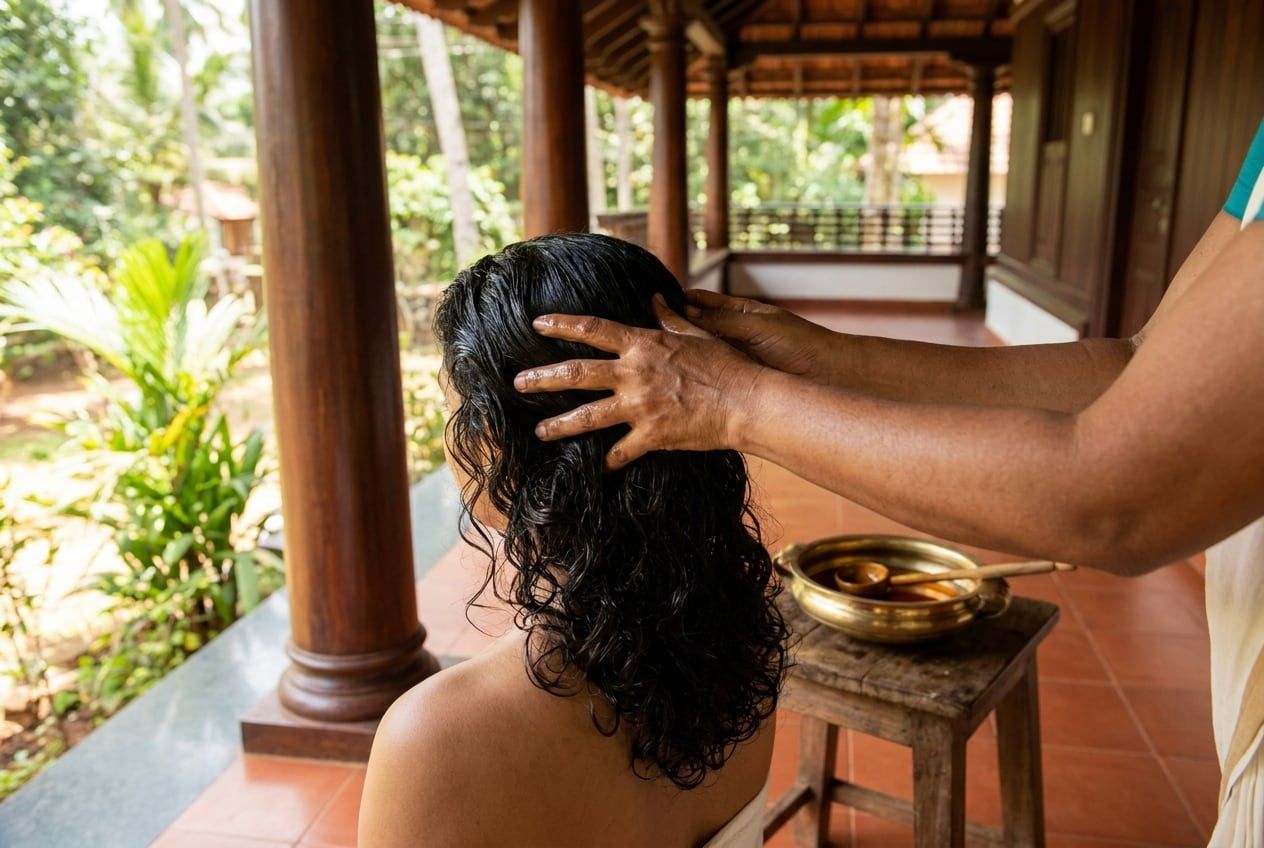
- Oil in the nose, ears and on the head. A few drops of oil in each nostril — nasya. The texts recommend oil in the ears and on the scalp for the sense organs and the hair.
- Abhyanga — oil massage. The Charaka Samhita explains it by comparison: just as a pot, a leather strap or a chariot axle becomes strong and lasts longer with oil, so does the body. More in the article on abhyanga.
- Exercise. At half strength: until light sweat appears on the forehead, in the armpits and along the spine. The texts warn specifically that excessive exertion does harm.
- Udvartana and bathing. After exercise the body is rubbed; with a tendency to kapha and excess weight, with a dry herbal powder. This is udvartana. Then bathing, which according to the texts removes fatigue and sweat and clears the mind.
The texts also include practices hardly anyone follows today: daily antimony for the eyes and inhaling medicinal smoke. We don’t advise repeating these at home. The eyes and airways are no place for experiments.
Food and sleep
On food, the fifth chapter of the Charaka Samhita says the essential thing: the quantity of food is determined by the strength of agni. The right portion is one that is digested on time and does not disturb well-being. Of heavy food the advice is to eat no more than a third or half of what you want; of light food, to satisfaction but not beyond.
From the same chapter comes the rule: eat when the previous meal has been digested and real hunger has come. Modern Ayurvedic practice puts the main meal in the middle of the day. Breakfast, according to Lad, depends on the season and agni: lighter in the heat and with weak digestion, more substantial in the cold. Dinner is light and early. The other rules of eating — what, with what and how to eat according to the classical texts — are covered in The Ayurvedic diet.
On sleep, the Charaka Samhita says that happiness, nourishment of the body, strength, fertility, knowledge and life itself depend on proper sleep. Proper sleep is at night, sufficient and timely. The texts count daytime sleep among habits that weaken agni and increase kapha. There are exceptions, but for a healthy person this is the general rule. Lad advises rubbing a little oil into the skin before bed: in his view it helps you sleep more soundly.
What you can realistically build into ordinary life
The whole classical list takes a good deal of time. A working person doesn’t have it, and doesn’t need it. It makes sense to go from the essential to the specific.
- Fixed times for getting up and going to bed. This is the foundation. It doesn’t have to be half past four: what matters more is that the time is the same and that you go to bed before midnight.
- The main meal in the daytime. A substantial lunch, a light early dinner. Snacks only if you are genuinely hungry.
- Five minutes of morning hygiene. A tongue scraper after brushing your teeth. It is the easiest thing to add.
- Morning movement. Fifteen to twenty minutes at half strength: walking, exercises, yoga.
- Oil when you have time. A full abhyanga once or twice a week before a shower. On other days, the feet before bed.
Be more careful with the rest. Nose drops and oil pulling are not suitable for children or people who have difficulty controlling swallowing. Oil massage has contraindications: it is not done with a fever, a cold or indigestion. Pregnant women and people with chronic illness should discuss any new practices with a doctor. Dinacharya is prevention for the healthy. It is not treatment and does not replace seeing a doctor.
One more thing. The texts stress that the routine is adapted to the person — their constitution, age, season and strength. Ayurveda has no one-size-fits-all timetable. Everyone’s balance of doshas is their own, and the dosha test shows which are pronounced in you.
Dinacharya on the school’s courses
On Ayurvedashala courses students do more than read about dinacharya. The clinic day follows the same principle: early rising, activities and meals by the time of day, early to bed. The day at the center in Rishikesh is organized the same way: yoga in the morning, consultations and treatments in the daytime, meditation and a walk to the river in the evening. Living like this for a few weeks is the simplest way to understand how it works. It is an experience a therapist can then pass on to clients first-hand, rather than retelling it from a book.
Sources
- Charak Samhita Online — 'Dinacharya': the daily routine with references to the Charaka Samhita, the Sushruta Samhita and Vagbhata's texts
- Charak Samhita Online — Matrashiteeya Adhyaya: the fifth chapter of the Charaka Samhita on the quantity of food and daily practices
- Charak Samhita Online — 'Dosha': predominance of the doshas by time of day, age and season
- Vasant Lad. The Daily Routine. The Ayurvedic Institute
Frequently asked questions
What time should I wake up according to Ayurveda?
The classical texts advise getting up before dawn, about 45–60 minutes before sunrise. Vasant Lad adjusts this by constitution: kapha types earliest of all, vata types around six in the morning.
Why scrape the tongue?
Tongue cleaning is described as far back as the Charaka Samhita as part of morning hygiene. It is an addition to brushing your teeth, not a replacement.
Do I have to do an oil massage every day?
The texts recommend daily abhyanga, but in ordinary life a few times a week or a short self-massage of the feet and head is enough. Oil massage is not done with a cold, a fever or indigestion.
Why is the main meal at midday?
In Ayurveda the middle of the day is the time of pitta, which is linked to the digestive fire. So the most substantial meal goes at lunch, and dinner is light and early.
Where do I start if I can't do it all at once?
With two things: get up and go to bed at the same times, and move your main meal to the middle of the day. Add the other elements one at a time.
Message us
We reply personally, tell you more and help you choose the program and dates. The message is pre-filled — just press Send.
We usually reply within a few hours.