
Treatments
Shirodhara: a Stream of Warm Oil on the Forehead
Shirodhara is a treatment in which warm oil or another liquid is poured onto the forehead in a thin stream for half an hour or more. How it works, the different types of dhara, what to do afterwards and who it doesn't suit.
What is shirodhara
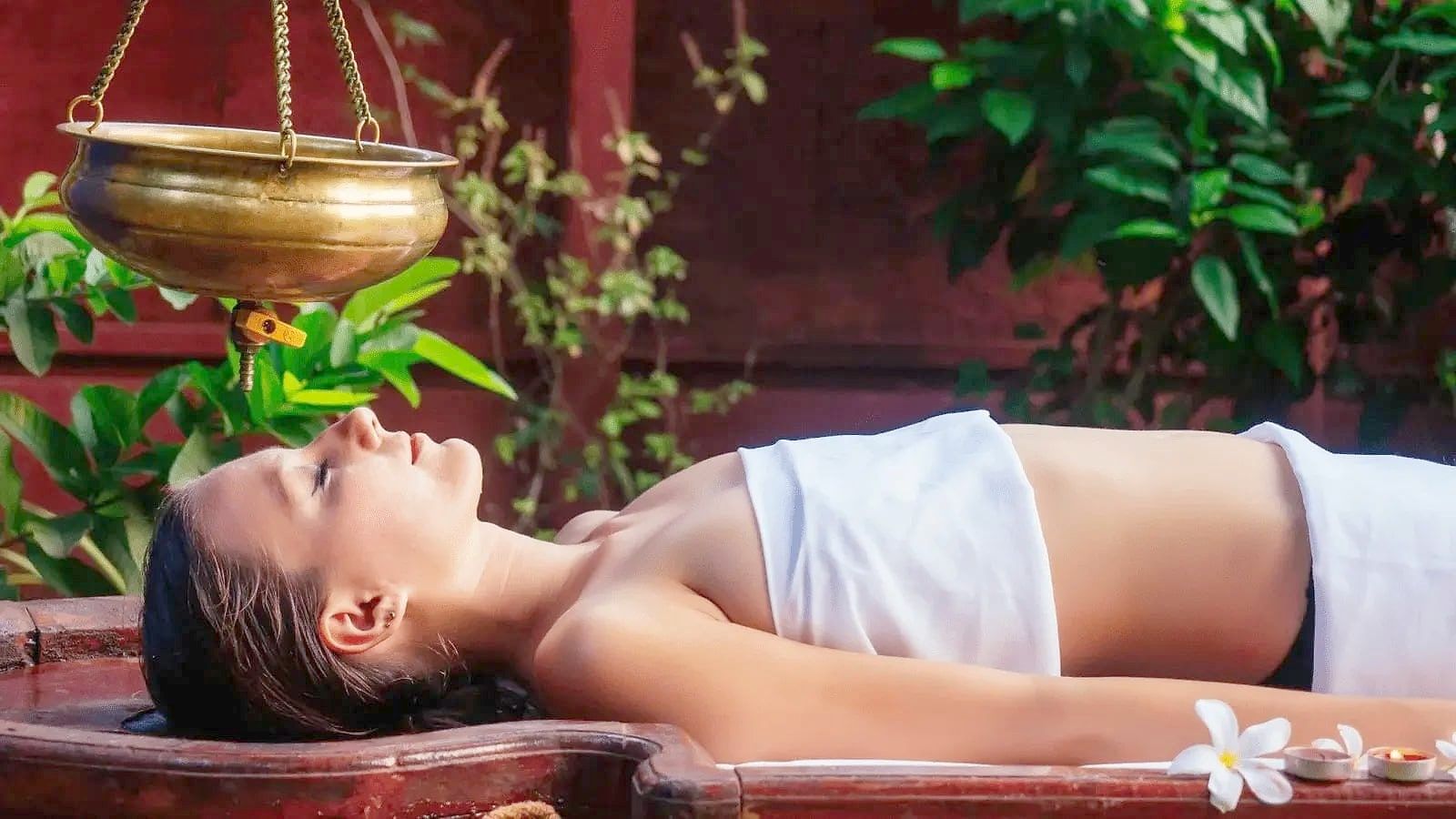
Shirodhara is a treatment in which a warm liquid is poured onto the forehead in a thin, continuous stream. In Sanskrit “shiro” means head and “dhara” means flow. Most often it is a medicated oil, but it can also be buttermilk, milk or a herbal decoction.
In the classical texts the treatment appears among the ways of applying oil to the head, under the name shira seka, “sprinkling the head”. The detailed rules were preserved by the Kerala tradition: the treatise Dhara Kalpa describes the vessel, the table, the height, the liquids and possible mistakes. The same treatise describes pizhichil, pouring oil over the whole body. In the form known today, shirodhara is very much a Kerala treatment. It is prescribed by a doctor, usually as a course and together with other treatments, for example after abhyanga.
How the treatment works
The equipment is simple, but every detail is specified.
- Table. A wooden table, the droni, with a raised edge and a drain: the liquid runs off the head, is collected, warmed again if needed and poured back into the vessel.
- Vessel. The dhara patra, also called the shirodhara bowl, is a clay or metal pot holding two to three liters, with a wide mouth and a round base. It hangs above the head. In the base is a hole about the width of a little finger, with a cotton wick passed through it: the liquid runs down the wick in an even stream, without splashing.
- Height. According to the texts, the end of the wick is four angulas — finger-widths — above the forehead. That is about 8–10 centimeters (3–4 inches). Any higher and the stream strikes; any lower and it loses its rhythm.
- Temperature. The oil is pleasantly warm, slightly warmer than the body, and is tested on the back of the hand. Liquid that has cooled is reheated during the session.
- Flow. The stream doesn’t stay in one place: the vessel is moved smoothly from temple to temple across the middle of the forehead. The speed and thickness of the stream stay constant throughout the session.
Before starting, the person receives a short head, neck and shoulder massage. A strip of cloth is tied above the eyebrows so that liquid doesn’t get into the eyes; the eyes and ears are covered with cotton wool. The person lies on their back with a small roll under the neck.
A session usually lasts 30–45 minutes. Sometimes the time is built up: starting with 15 minutes and adding five minutes a day. The old texts also mention longer sessions, up to an hour and a half, but in modern practice this is rare. The treatment is given in the morning, avoiding the midday heat. A course is 7, 14 or 21 days, as the doctor decides. One person’s oil is used for several days and then replaced; milk and buttermilk are prepared fresh every day.
Types of dhara
The liquid is chosen according to the person’s condition and which dosha is out of balance.
- Taila dhara. A stream of medicated oil — the best-known type. Oil is warm, heavy and unctuous, so it is traditionally chosen for vata conditions: anxiety, dryness, shallow sleep. Ksheerabala or oils with brahmi and jatamansi are often used — these are medicated oils cooked with herbs, and the doctor chooses them.
- Takradhara. Instead of oil, a medicated buttermilk prepared with herbs, most often with amla. In the Kerala tradition it is prescribed when heat and pitta and kapha conditions predominate; its use has been described for some skin conditions and for high blood pressure. The buttermilk isn’t heated, but it isn’t poured cold either: the texts warn that cold buttermilk can bring on a cough and chills.
- Ksheeradhara. A stream of milk, usually cooked with herbs. A cooling type of dhara, traditionally chosen for pitta and vata conditions — a feeling of heat in the head, irritability, insomnia.
Herbal decoctions, ghee, water or coconut water are used less often. The type of dhara is not a matter of taste: according to the same texts, the wrong liquid can make a condition worse.
Where the nervous system comes in
Ayurveda has no concept of a “nervous system”, but it has a picture close to it in meaning. The Charaka Samhita calls the head the most important part of the body: the sense organs and prana, the vital breath, are concentrated there. The movement of thought, speech and the senses is governed by vata. When vata is aggravated, the mind becomes restless and dry, just like the body: thoughts jump, sleep is shallow, the person is tired but can’t stop.
Warm oil has qualities opposite to vata — it is heavy, unctuous, warm and flowing. From the ayurvedic point of view, an even, continuous stream onto the forehead calms vata where it acts on the mind and senses. That is why shirodhara is traditionally used for anxiety, sleep problems and headaches, and, as part of comprehensive treatment under a doctor’s supervision, for neurological conditions.
Who should not have it
Shirodhara is not given, or is postponed:
- With a fever, a cold or an acute infection.
- With inflammatory conditions in the head area. Conjunctivitis and glaucoma are specifically named, as are space-occupying lesions of the brain.
- With pronounced kapha conditions. A blocked nose and sinuses, a runny nose, a productive cough, heaviness in the head — oil dhara is contraindicated here.
- With indigestion and signs of ama — undigested residue: heaviness, nausea, a coated tongue. More in the article on agni and ama.
- On the eve of and immediately after cleansing procedures — therapeutic emesis or purgation.
- In extreme heat or cold, at midday and at night — these restrictions come from the texts.
- With wounds, rashes and infections of the skin of the scalp and forehead.
In pregnancy, epilepsy, psychiatric disorders, after head and neck injuries, and when taking sleeping pills or sedatives, the decision is made only by a doctor. Shirodhara does not replace treatment by a psychiatrist or neurologist. This article does not replace a consultation.
Aftercare
After the session the oil is wiped off the head and hair with a cloth. A pinch of herbal powder, rasnadi churna, is rubbed into the crown: it is believed to stop the oil on the head from causing a runny nose and heaviness. Then the person rests quietly for between half an hour and 40–50 minutes. Only after that are the hair and body washed, and only with warm water.
On the day of the treatment the advice is:
- Protect your head. Don’t go out bareheaded into wind, cold, dust or bright sun.
- Don’t sleep during the day, and don’t stay up late.
- Don’t overload yourself. No heavy physical work, loud or long conversations or emotional strain.
- Eat light, warm food and drink warm water.
The usual reaction is deep relaxation, drowsiness and a sense of quiet in the head. If a headache, chills, a runny nose or nausea appear, tell the doctor: the texts link them to mistakes in temperature, height or duration, and the plan is adjusted.
How clinical shirodhara differs from the spa version
In a spa, shirodhara is usually offered as a one-off “relaxation ritual”: the same oil for everyone, twenty minutes, no questions about health. In a clinic the person is seen by a doctor before the treatment. The doctor decides whether dhara is needed at all, which kind — oil, buttermilk or milk — how many minutes and how many days. The therapist watches the temperature, height and rhythm of the stream throughout the session, and afterwards the person isn’t sent straight outside. Most importantly, shirodhara in a clinic is given as a course and fits into an overall plan together with diet, routine and other treatments, as in panchakarma. In our programs — in Varkala and in Rishikesh — shirodhara is likewise prescribed by the doctor according to indications, not chosen by the guest. The same line runs through other treatments too — see Spa vs ayurveda: what’s the difference.
On the two-week course at a Kerala clinic, shirodhara is taught hands-on: how to prepare the table and vessel, set the height and flow, keep the temperature, guide the stream, recognize mistakes and look after the person after the treatment — and when the therapist must stop and call the doctor.
Sources
Frequently asked questions
How long is a shirodhara session, and how many sessions are needed?
The stream itself usually runs for 30 to 45 minutes; sometimes the time is built up gradually, starting from 15 minutes. A course traditionally runs 7, 14 or 21 consecutive days; the doctor decides how long.
Does shirodhara help with insomnia?
In ayurveda it is traditionally prescribed for sleep problems — as a course and after a doctor's examination.
What is takradhara?
It is the same treatment, but instead of oil a medicated buttermilk prepared with herbs is poured onto the forehead. In the Kerala tradition it is chosen when heat and pitta and kapha conditions predominate and oil would be too heavy.
Can I wash my hair after shirodhara?
Not right away. The oil is wiped off with a cloth, you rest for at least half an hour, and only then is the hair washed, with warm water, not cold. On that day the head is protected from wind, cold and sun.
Does it hurt, and can I fall asleep during the treatment?
The treatment is painless. Many people drift into a drowsy state — that is a normal reaction. Unpleasant sensations are usually due to mistakes: liquid that is too cold or too hot, the wrong height, or a session that runs too long.
Message us
We reply personally, tell you more and help you choose the program and dates. The message is pre-filled — just press Send.
We usually reply within a few hours.