
Treatments
Ayurveda vs Spa: What a Spa Is and How They Differ
A spa is a place and a set of treatments for relaxation and self-care. Ayurveda is India's traditional medicine, where treatments are prescribed according to a person's condition. They often appear on the same menu, but they work differently. What the difference is, and which to choose when.
What is a spa, in plain terms
A spa is a place where people rest and look after themselves with the help of water, massage and treatments for the body and face. The International Spa Association (ISPA) defines spas as places devoted to overall well-being through a variety of professional services that encourage the renewal of mind and body.
Spas come in many kinds. ISPA distinguishes hotel and resort spas, destination spas that people travel to for several days, mineral springs spas, medical spas, club spas and day spas in town. What they share is that people come to rest, relax and enjoy pleasant care. Diagnosing and treating illness is not the job of an ordinary spa, and a good spa doesn’t promise it. Trips of several days for rest and practice are also sold today under the word “retreat” — how these differ from one another is explained in What is a retreat.
Where the word “spa” comes from
The word comes from the name of the town of Spa in eastern Belgium, in the province of Liège. It has mineral springs that have long been considered healing. The Romans called the place Aquae Spadanae, and it was known as a resort as early as the fourteenth century. According to the etymological dictionary, the name itself is linked to the Walloon word “espa”, meaning spring or fountain.
Spa became a fashionable resort in the sixteenth century, when physicians — including the physician of England’s King Henry VIII — wrote about the benefits of its waters. People came to drink the water and bathe, and that was the original “spa”: treatment with water at a resort, not a massage in a city salon.
In English “spa” became a general word for a medicinal spring in the seventeenth century, while the meaning “an establishment offering health and beauty treatments” appeared only by the 1960s. In 2021 the town of Spa became part of the UNESCO World Heritage site “Great Spa Towns of Europe”.
It is often said that “spa” is an acronym of the Latin “sanus per aquam” or “salus per aquam”, “health through water”. This is an attractive but doubtful theory. The expansion isn’t found before the early twenty-first century and doesn’t match the Roman name of the place, so it is considered a later invention.
What spa treatments are
Spa treatments usually mean everything done in a spa for relaxation and care:
- Massages — classic, relaxing, hot stone, aromatherapy.
- Body care — peels, scrubs, wraps.
- Facial care — cleansing, masks, face massage.
- Water and heat — pools, baths, sauna, hammam.
- Spa rituals or spa programs — several treatments in a row as one program, for example a scrub, a wrap and a massage.
A good spa means professional therapists, cleanliness, attention to the client and a calm setting. It is a normal and useful part of life: rest is valuable in itself.
What ayurveda is
Ayurveda is India’s traditional medicine. It is a system that combines herbal remedies, diet, physical activity and lifestyle. At its core is the idea of the three doshas — vata, pitta and kapha — and of health as their balance. More in What is ayurveda.
In ayurveda, oil treatments are one part of a larger treatment. They are prescribed by a doctor after an examination, together with a daily routine and diet. What people know from spa menus is only the outer, gentlest part. Beyond it, ayurveda has the cleansing panchakarma programs, which are carried out only under a doctor’s supervision and are not transferred to spas.
The difference between a spa and ayurveda
- Purpose. In a spa — pleasure, rest, self-care. In ayurveda — restoring balance by prescription, for a specific condition.
- Who performs it. In a spa — a massage therapist or spa therapist. The exception is medical spas, where doctors work. In an ayurvedic clinic — a therapist working to a doctor’s prescription.
- Consultation. In a spa there is usually a short questionnaire. In ayurveda a consultation comes before the treatment: digestion, sleep, pulse, complaints, constitution.
- Personalization. In a spa the treatment is the same for everyone, except perhaps for the scent and pressure. In ayurveda the oil, duration and sequence are chosen for the person.
- Contraindications. In a spa the restrictions are the general ones for massage. Ayurveda adds its own: the Ashtanga Hridaya, for example, advises against oil massage during indigestion, with excess kapha and right after cleansing procedures.
- Duration. A spa is usually a one-off visit. Ayurveda counts on a course of several consecutive days.
- Afterwards. After a spa you can go straight back to your day. After an ayurvedic oil treatment, warmth, rest and light food are advised, and the oil is washed off with warm water, not cold.
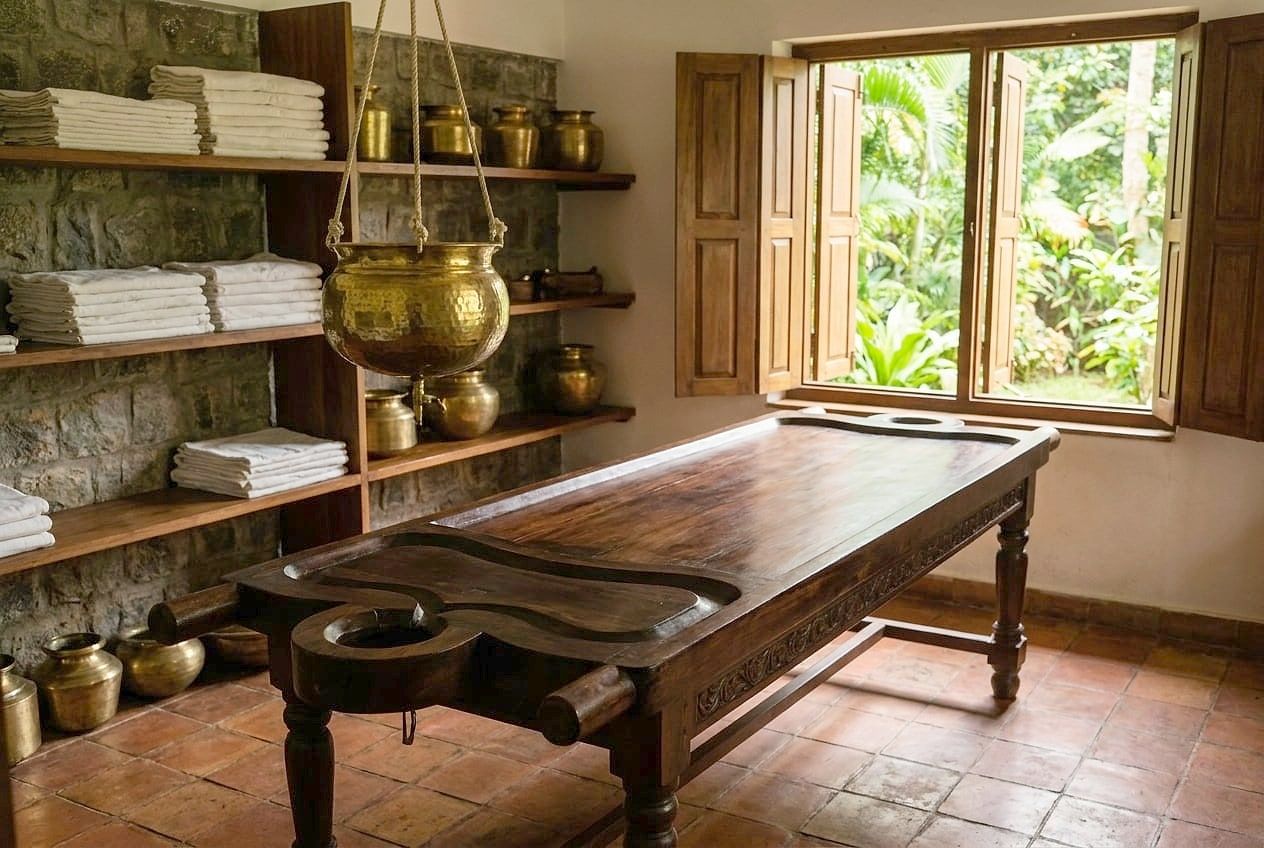
- Setting. A spa creates an atmosphere: music, scents, dim lighting. A Kerala treatment room is simpler: a wooden table, brass vessels, cotton cloths. The point of the treatment is not in the interior.
None of these differences makes a spa worse. They are simply different tasks: a spa answers the question “how do I relax”, ayurveda the question “what is happening with my health and what do I do about it”.
Where spa and ayurveda overlap
Spa menus have long included treatments of ayurvedic origin: full-body oil massage, head and foot massage, shirodhara. That is fine: many of them really are pleasant and suit relaxation, as long as contraindications are respected. An honest spa version doesn’t have to be therapeutic. It is enough that the therapist knows the technique, warms the oil, asks how you feel and doesn’t promise what the treatment doesn’t deliver.
The problem starts when only the name is left of ayurveda. Signs of such a substitution:
- Nobody asks anything about how you feel, your digestion, a fever, pregnancy.
- One oil for everyone, cold or heavily scented.
- Arbitrary technique, with no sequence and no separate work on the head and feet.
- Promises to “flush out toxins” or “cure” something in one session.
What a genuine treatment looks like is covered in the articles on ayurvedic massage and abhyanga. Which treatments transfer to a spa menu without losing anything and which stay in the clinic is explained in Ayurvedic treatments on a spa menu.
Ayurveda spa: what the name means
An ayurveda spa is a spa that builds its menu around treatments of ayurvedic origin. The name is used for a single room in a hotel, for a resort’s entire spa complex and for a city salon with one or two oil treatments. The word “ayurveda” in the name tells you where the treatments come from, not that there is an ayurvedic clinic inside.
The same questions as above help you tell one from the other. Is there an ayurvedic doctor on staff who sees the person before the treatment? Is the oil chosen for you, or is it the same for everyone? What happens with contraindications — do they say no, or do a “lighter” version? Do they offer a course of several days with a routine and diet, or is every visit a one-off? If there is no doctor and everything is one-off, it is a spa with ayurvedic treatments, and for relaxation that is a good choice. If there is a consultation, a prescription and a course, you are closer to ayurveda in its therapeutic sense — and the cleansing part, panchakarma, is in any case carried out only in a clinic.
What to choose, and when
- You want to rest, relax and shake off a working week’s tiredness — a spa is perfect.
- You are curious about an ayurvedic treatment as an experience — you can try it in a spa, but ask which oil they use and who trained the therapist.
- You want to sort out your well-being, sleep or digestion — that is a question for an ayurvedic doctor, not for a spa menu. The doctor will prescribe treatments, routine and diet and explain what you can expect from them.
- You have a chronic illness, are pregnant or have had recent surgery — see a doctor first, for the spa and for ayurveda alike.
This article does not replace a consultation.
If you work in a spa
For spa therapists, massage therapists and beauticians, ayurvedic treatments offer what many spa menus lack — a treatment with meaning and clear rules. At Ayurvedashala, a school of ayurveda in India, abhyanga, head, face and foot massage, shirodhara and working with oils are taught hands-on at a clinic in Malabar, together with contraindications and client intake. Details are on the courses for spa professionals page.
Sources
- Online Etymology Dictionary. Spa (n.)
- Wikipedia. Spa — section on etymology and the 'salus per aquam' theory
- Wikipedia. Spa, Belgium
- International Spa Association (ISPA). About ISPA — definition of a spa and types of spa
- Ashtanga Hridaya, Sutra Sthana, chapter 2 'Dinacharya': abhyanga and when to avoid it (English summary, Easy Ayurveda)
Frequently asked questions
Is 'spa' an acronym?
Probably not. The word comes from the name of the Belgian town of Spa, with its mineral springs. The expansion 'sanus per aquam' — 'health through water' — is popular in advertising, but according to dictionaries it appeared much later than the word itself.
What do spa treatments include?
Usually massages, face and body care, wraps and peels, water treatments, and a sauna or hammam. The range depends on the particular spa.
Is an ayurvedic massage in a spa real ayurveda?
Sometimes it is, and sometimes it is an oil massage with an ayurvedic name. The difference lies in whether you are asked questions before the treatment, whether the oil is chosen for you and whether contraindications are respected.
What is an ayurveda spa?
It is a spa whose menu includes treatments of ayurvedic origin: full-body oil massage, head and foot massage, shirodhara. It is a spa format for relaxation rather than treatment: there is usually no doctor's consultation and no cleansing procedures.
Which is better for relaxation — a spa or ayurveda?
A spa is a fine choice for rest and relaxation. Ayurveda is what you need when you want to sort out your well-being, routine and diet under a doctor's eye and are ready for a course.
Message us
We reply personally, tell you more and help you choose the program and dates. The message is pre-filled — just press Send.
We usually reply within a few hours.