Basics
Siddha Medicine: Tamil Nadu's Own System, Not Ayurveda
Siddha is often called 'southern ayurveda', but it is a separate medicine with its own texts in Tamil, its own teachers and its own diagnostics. Where it comes from, what it rests on, how it treats, where to find it in Tamil Nadu and how it differs from ayurveda.
What is siddha
Siddha is the traditional medicine of Tamil Nadu, a state in south-eastern India. It is often called “southern ayurveda”, but that is inaccurate. Siddha is a separate system with its own texts, its own teachers, its own diagnostics and its own place in India’s public health system.
The word “siddha” means “one who has attained perfection” or “established truth”. In the Tamil tradition siddha is called the medicine of the ancient Tamils, a people who speak one of the Dravidian languages of South India. All its classical literature is written not in Sanskrit, like ayurveda’s, but in Tamil.
Siddha has a lot in common with ayurveda: the five elements, three vital forces, great attention to diet and lifestyle. But the differences are enough for India to recognize them as two different medicines. How the regional schools of ayurveda itself are organized is covered in Ayurveda in India: traditions and regional schools.
The siddhars and Agastya
In the Tamil tradition, siddhars are sages who, according to legend, mastered knowledge of nature, the body and the spirit and gained special powers, siddhis. They were wandering ascetics who were at the same time physicians, alchemists, astrologers and poets. They wrote down their knowledge in verse on palm leaves.
The tradition names eighteen principal siddhars. The list includes names known beyond Tamil Nadu: Agastya, Tirumular, Patanjali, Dhanvantari. Legend links the siddhars with the mountains of South India — for example Sathuragiri, where they are believed to have lived for centuries.
The first among the siddhars is considered to be Agastya, Agathiyar in Tamil. He is revered as the founder of siddha medicine, and legends also credit him with the first grammar of the Tamil language. According to tradition, the knowledge itself came from the god Shiva: he passed it to his consort Parvati, she to Nandi, and from there it reached the siddhars.
Dates call for caution here. Tradition speaks of deep antiquity, and the National Institute of Siddha in Chennai traces the system as far back as the Indus Valley civilization. Historians see it differently: the medical texts that have come down to us under Agastya’s name are dated no earlier than the fifteenth or sixteenth century. The scholar of Tamil literature Kamil Zvelebil believed that three or four different people from different eras stand behind this name and merged over time into a single figure. So it is more accurate to say that siddha is an old living tradition, but its written sources are mostly late medieval.
The Tamil texts
Siddha literature is above all poetry. Each verse-recipe gives the disease, the name of the medicine, its ingredients and proportions, and how to prepare and take it. Many palm-leaf manuscripts are still kept by families in Tamil Nadu and passed down the generations. Some have found their way into university collections in India, Europe and the US.
The texts are signed with the names of siddhars, and their titles often include the number of verses. The National Institute of Siddha lists among the important works “Yugi Chintamani 800”, a large book on bodily and mental illness, “Bogar 7000”, and works attributed to Agastya on mental disorders, childhood diseases and the preparation of medicines. Separate books are devoted to karpam, the rejuvenating remedies discussed below.
Today the Tamil siddha texts are being digitized and gathered into databases, so that they can be studied systematically rather than manuscript by manuscript.
The foundations of siddha: elements, three forces, 96 tattvas
The central idea of siddha is the unity of the human being and the universe. A Tamil formula says: what is in the universe is also in the body. Everything — the body, food, medicines, the causes of disease — is made of the five elements: earth, water, fire, air and space.
The elements combine into three vital forces, “uyir thathukkal”. Put simply:
- Vatham, or vali, — from air and space. Responsible for movement.
- Pitham, or azhal, — from fire. Responsible for heat, digestion and metabolism.
- Kabam, or iyam, — from earth and water. Responsible for the body’s stability and moisture.
These are direct relatives of the ayurvedic doshas — vata, pitta and kapha. But siddha describes their balance in its own way. According to the tradition, in a healthy body vatham, pitham and kabam stand in the proportion 4 : 2 : 1, and disease begins when this proportion is disturbed. It is affected by climate, season, diet, physical exertion and emotional strain. Like ayurveda, siddha distinguishes body types by the predominant force and gives each its own dietary advice.
Broader than the three forces is the teaching of the 96 tattvas, the basic principles of which, according to siddha, a human being is made. The list includes the five elements, the organs of sense and action, the mental faculties, the vital winds, the three forces, the seven body tissues, the passions and the states of the soul. The tattvas take in the body, the mind and the spiritual side of a person. According to the tradition, a disturbance of the three forces can cause 4,448 diseases — a number that appears often in siddha texts.
The regimen has a special place. The rules of pathiyam and apathiyam — what is and isn’t allowed during treatment — matter as much in siddha as the medicine itself.
How a siddha doctor makes a diagnosis
Siddha has its own method of examination — en vagai thervugal, “eight kinds of examination”. The doctor assesses:
- naadi — the pulse;
- sparisam — sensations on touching the body;
- naa — the tongue;
- niram — color;
- mozhi — voice and speech;
- vizhi — the eyes;
- malam — the stool;
- moothiram — the urine.
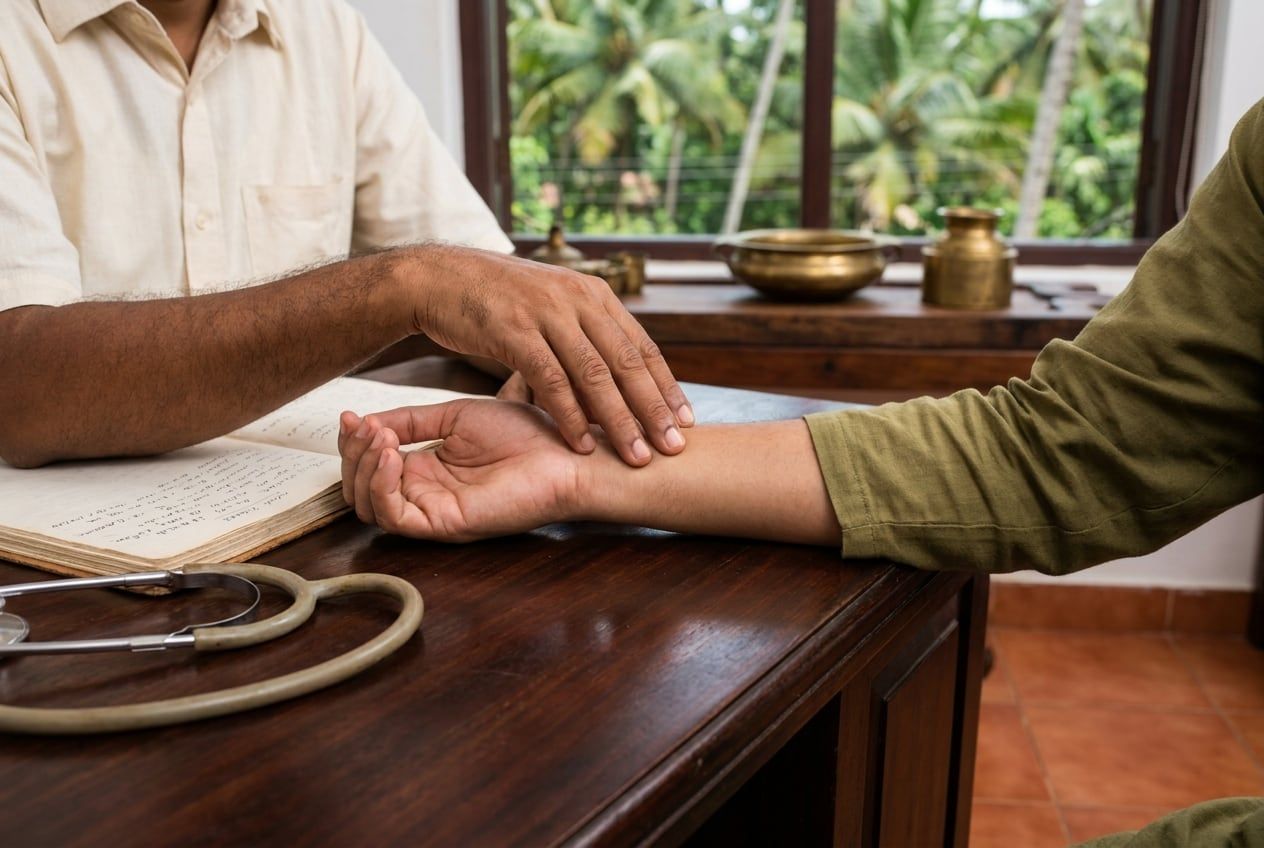
From these eight signs the doctor determines which of the three forces is disturbed, what has caused the disease, how to treat it and what to expect. The pulse is considered decisive: the final conclusion is drawn from naadi, felt with the fingers at the wrist. Pulse reading exists in ayurveda too, but in siddha it takes the central place, and the Tamil tradition regards the siddhars as the first masters of pulse diagnosis.
A distinctive feature of siddha is careful examination of the urine. The doctor looks at its color, smell, froth and sediment, and for the neikuri test places a drop of sesame oil on the surface of the urine and watches how it behaves. According to the tradition, a drop that spreads like a snake points to vatham, one that forms a ring to pitham, and a drop that stays round like a pearl to kabam.
Medicines: herbs, minerals and metals
The siddha pharmacy divides medicinal substances into three groups: plant, mineral and animal. The minerals are in turn classified in detail: salts, minerals, metals, sulfur. This is one of the most developed parts of siddha.
The forms of medicine are systematized too. By tradition there are 64 of them: 32 for internal use and 32 for external use. The internal ones include powders (chooranam), decoctions (kudineer), leaf juices and thick medicated pastes (lehyam). The mineral forms for which the siddhars are famous stand apart:
- Parpam — a calcined powder of minerals or metals.
- Chenduram — a red calcined powder.
- Mezhugu and kattu — special dense preparations; kattu is made so that it withstands fire.
Minerals and metals are purified, ground with herbal juices and calcined in a fire of dried cow-dung cakes, the number of which is measured out in advance. According to siddha, this processing makes the substance safe and assimilable.
Mineral preparations are potent remedies, and how thoroughly a particular one has been processed can’t be checked from the outside. So the rules are simple:
- siddha mineral preparations are taken only on the prescription of a qualified doctor who sees the person and manages the treatment;
- they are bought from reputable manufacturers, not at a market or at random online;
- your own doctor at home must be told what you are taking.
Most siddha treatment, though, is herbal: decoctions, powders and plant oils.
Varmam and thokkanam
Varmam is the teaching of the body’s vital points. The word means “hidden”. According to siddha, life force gathers at the places where ligaments, nerves, bones, vessels and joints meet, and these points are called varmams.
Varmam has two sides. The martial one, varma kalai, strikes the points to disable an opponent; it is studied at the higher levels of Tamil and Kerala martial arts. The therapeutic one, vaidhya murai, uses the same points to help with pain, stiffness and the after-effects of injury. Therapeutic varmam is part of siddha medicine.
Legend says that Shiva revealed the knowledge of the points to his son Murugan, who passed 108 varmams to the sage Agastya. Today it is mainly Agastya’s school that is practiced in Tamil Nadu. Therapeutic varmam is especially well known in the south of the state, in Kanyakumari district, which even has an association of varmam masters, and in the neighboring southern districts of Kerala. It is part of South India’s wider tradition of folk orthopedics: setting dislocations and treating fractures and injuries.
Thokkanam is siddha’s therapeutic massage, one of its 32 external therapies. The name is linked with the words for “skin” and “support, tone”. There are nine classical techniques — among them tapping, pressing, grasping, twisting and bending. The doctor chooses them according to the condition; the massage is done with or without a medicated oil. Its main use is for vatham disorders: chronic pain and stiffness in the joints and muscles.
Kaya kalpa: rejuvenation the Tamil way
Kaya kalpa is kayakarpam in Tamil. The National Institute of Siddha calls it a distinctive feature of the whole system. Its aim is to strengthen the body, protect it from disease and slow down aging. “Kaya” means body and “kalpa” means transformation. In ayurveda the same ground is covered by a branch of its own, rasayana.
Kayakarpam combines two paths:
- Karpa medicines. Plant, mineral and animal preparations for rejuvenation. Separate texts of the siddhars are devoted to them.
- Karpa yoga. A way of life: breathing exercises, yoga, meditation, rules of conduct and purity of thought.
A simple example from the tradition is a routine with ginger and haritaki: fresh ginger with hot milk in the morning, dried ginger with food in the afternoon, powdered haritaki fruit with water at night. Kayakarpam is believed to work better if the body is cleansed first.
It sounds like a promise of eternal youth, so a sober view is important. Kayakarpam is a philosophy of long-term care for one’s health, not a cure for aging. Mineral “karpams” follow the same safety rules as all other preparations containing metals.
Siddha today
In India the traditional medicines are brought together under a dedicated ministry, the Ministry of AYUSH. Siddha has its own line in it, alongside ayurveda, yoga and naturopathy, unani, sowa-rigpa and homeopathy.
- Education. In Tamil Nadu, training as a siddha doctor takes five and a half years on the Bachelor of Siddha Medicine and Surgery (BSMS) program. After that, MD and PhD degrees in siddha are possible. Graduates register as siddha doctors and prescribe medicines from the official siddha pharmacopoeia.
- Colleges. The Government Siddha Medical College in Palayamkottai, Tirunelveli district, opened in 1964, and the Government Siddha Medical College in Chennai, in Arumbakkam, in 1985. Both are part of the Tamil Nadu state medical university.
- National Institute of Siddha. The system’s main center is in Chennai, in Tambaram. It opened on 3 September 2005 as a joint project of the Government of India and the state of Tamil Nadu. The institute has a hospital with free outpatient consultations and 120 inpatient beds.
In India siddha is a state-recognized traditional medicine, but not a replacement for conventional treatment.
Where to find siddha in Tamil Nadu
Siddha is alive above all in Tamil Nadu. If you want to get to know it, it is best to start with government institutions.
- Chennai. The National Institute of Siddha in Tambaram, with its hospital, and the Government Siddha Medical College in Arumbakkam.
- Tirunelveli. The Government Siddha Medical College in Palayamkottai, the oldest of the government siddha colleges.
- Kanyakumari and the south of the state. The land of therapeutic varmam and hereditary masters.
Besides doctors with degrees, folk healers — vaithiyars — practice in Tamil Nadu. Often they are hereditary experts who learned from a father or a teacher. Their experience can be valuable, especially in varmam and the treatment of injuries. But preparations containing minerals and metals are more safely obtained from a registered doctor who can explain the composition and supervise the treatment.
How siddha resembles ayurveda and how it differs
Similarities:
- both start from the five elements and three vital forces — vatham, pitham and kabam in siddha, vata, pitta and kapha in ayurveda;
- both look at the whole person: build, age, season, diet and lifestyle;
- both give great weight to diet and routine, not just to medicines;
- both use preparations made from minerals and metals and face the same questions about their safety.
Differences:
- language and texts — siddha has the Tamil verses of the siddhars, ayurveda the Sanskrit treatises of Charaka, Sushruta and Vagbhata;
- teachers — siddha has eighteen siddhars headed by Agastya, ayurveda its own sages and authors of the samhitas;
- diagnostics — in siddha the pulse is the decisive sign, and there is a distinctive urine test with a drop of oil;
- pharmacy — mineral preparations take up an especially large place in siddha;
- its own methods — varmam, thokkanam and kayakarpam as a whole field;
- place in the state system — separate colleges and a national institute of its own.
Siddha and ayurveda are neighbors that grew from common Indian soil but speak different languages. How the schools of ayurveda itself differ — the Kerala school, the northern one and others — is covered in Ayurveda in India: traditions and regional schools.
Sources
- National Institute of Siddha, Chennai. Siddha medicine: karpam, varmam, psychiatric texts of the siddhars
- National Institute of Siddha, Chennai. History of NIS
- National Health Portal of India. Siddha Pharmacology
- Ministry of Ayush. National Institute of Siddha (NIS), Chennai
- Department of Indian Medicine and Homoeopathy, Government of Tamil Nadu. Government Siddha Medical College, Palayamkottai
- Wikipedia. Agastya (section on the dating of the siddhars' medical texts); Siddhar; Varma kalai; Tattva (Siddha medicine)
Frequently asked questions
Is siddha a type of ayurveda?
No. It is an independent traditional medicine of Tamil Nadu with its own literature in Tamil, its own curricula and national institute. It shares with ayurveda the ideas of the five elements and three vital forces, but its diagnostics, medicines and special methods are its own.
Who are the siddhars?
In the Tamil tradition this is the name for sages who attained perfection: they were ascetics, physicians, alchemists and poets all at once. The tradition names eighteen principal siddhars, with Agastya considered the first among them.
Are siddha mineral preparations safe?
They are potent remedies and need careful handling. They should be taken only on the prescription of a qualified doctor and from a reputable manufacturer, never bought at random.
Where in India can I see a siddha doctor?
Above all in Tamil Nadu. The largest center is the National Institute of Siddha in Chennai, with its hospital. There are government siddha colleges with clinics in Chennai and Palayamkottai, and therapeutic varmam is especially well known in the south of the state, in Kanyakumari.
What is varmam?
The teaching of the body's vital points. It has two sides: a martial art, and a therapeutic practice that works through the points to help with joint and muscle pain, after injuries and in some nervous disorders. Therapeutic varmam is done by a trained specialist.
Message us
We reply personally, tell you more and help you choose the program and dates. The message is pre-filled — just press Send.
We usually reply within a few hours.