
Basics
Ayurveda and Yoga: What They Share and How They Differ
Ayurveda and yoga are often called sister sciences, and with good reason: a shared worldview, a shared language, even a shared ministry in modern India. But their subject matter is different, and their tools should not be confused. Here is what they really have in common, how their goals differ and why the shatkarma of hatha yoga is not panchakarma.
Why they are called sister sciences
Ayurveda and yoga grew up in the same culture and speak the same language. Tradition regards Ayurveda as a supplement to the Vedas, India’s oldest texts, while yoga is listed among the six classical schools of Indian philosophy (darshanas), alongside Samkhya, Nyaya, Vaisheshika, Mimamsa and Vedanta. Different shelves, but one library.
They share three things, and none of them is superficial.
- One worldview. Both Ayurveda and yoga start from the idea that a human being is made of the same elements as everything around, and that consciousness stands behind the body. Samkhya set this out in the most detail, and both systems draw on its analysis.
- The three gunas. Sattva, rajas and tamas — clarity, movement and inertia. In yoga these are qualities of all nature; Ayurveda took the same triad and uses it to describe the temperament of the mind, alongside the three doshas that describe the body.
- A shared vocabulary. Prana, agni, nadi, ojas, shatkarma, basti — words found in both. Sometimes they mean the same thing, sometimes not, as we will see below.
Modern India has made the kinship official: Ayurveda and yoga sit in the same ministry, AYUSH, where the “Y” stands for yoga and naturopathy. How the country’s other traditional systems are organized is covered in Ayurveda traditions in India.
Where they part ways
Kinship does not make them interchangeable, because their subject matter differs.
Ayurveda states its task literally: preserve the health of the healthy and relieve the disorder of the sick. Everything it contains follows from that — diagnosis, diet, routine, medicines, procedures. It is a medicine with its own idea of the norm and of deviation from it.
Patanjali’s Yoga Sutras set a different task: to still the movements of the mind. The eight limbs of practice are built towards that goal, not towards treatment:
- yama and niyama — rules of conduct towards others and oneself;
- asana — a steady posture of the body;
- pranayama — work with the breath;
- pratyahara — withdrawing attention from sense impressions;
- dharana, dhyana, samadhi — three degrees of concentration.
Asana comes third of eight on this list and is a precondition for the limbs that follow: you cannot sit long and still if the body is not ready for it. What a modern studio calls yoga occupies one limb out of eight in the classical list — another difference worth knowing when comparing the systems.
The Charaka Samhita knows the word “yoga” and speaks of liberation from suffering, but its own subject is different, and it does not treat with yoga. The classical texts of yoga, in turn, contain neither dosha diagnosis nor a pharmacopoeia. The systems refer to each other but do not do each other’s work.
- Ayurveda answers the question “what is wrong with me and what should be done about it”.
- Yoga answers the question “how do I handle my attention”.
Why shatkarma is not panchakarma
The most common confusion is around cleansing, and it deserves a closer look.
Shatkarma are the six cleansing actions of hatha yoga described in the Hatha Yoga Pradipika: dhauti, basti, neti, trataka, nauli and kapalabhati. They are part of practice, preparing the body and breath for the higher limbs.
Panchakarma are the five therapeutic procedures of Ayurveda: vamana, virechana, basti, nasya and raktamokshana. They are a medical intervention that a doctor prescribes after an examination, supervises, and frames with preparation and recovery. How it works is explained in What is panchakarma, in plain words, and the preparatory stage in the article on preparing for panchakarma.
They do share one name — basti. In hatha yoga it is a water practice that the practitioner performs alone; in Ayurveda basti is a medicated enema of oil or decoction that a doctor prescribes and formulates. One word, different procedures, and the second cannot be replaced by the first. Panchakarma has contraindications, and the decision about it is made not by the practitioner but by an Ayurvedic doctor.
Where yoga fits in the Ayurvedic daily routine
Ayurveda has its own answer to the question of where physical practice belongs in the day — dinacharya, the daily routine. The morning is given to what gets the body moving after sleep: cleansing, self-massage with oil, and then a short effort at half strength — walking, exercise or yoga. In the Ashtanga Hridaya, Vagbhata spells out the measure: effort is beneficial as long as it does not exhaust. What such a day includes in full is described in Dinacharya.
Hence the Ayurvedic view of practice: it is not about a set of asanas but about dose and timing. The same work done to exhaustion or at the wrong hour stops being beneficial in this logic.
Practice by dosha: where it comes from
Books and courses often allocate practice by dosha: slow and supported for vata, cool and non-competitive for pitta, brisk and warming for kapha. To be clear: the classical texts contain no such allocation. It comes from modern schools of Ayurvedic yoga therapy and rests on Ayurveda’s general rule of choosing the opposite quality. The same rule governs the choice of massage oil.
It is a sensible rule, but it is not a prescription. You can get a rough idea of which doshas are pronounced in you from the online test and read about them in the articles on vata, pitta and kapha. Matching treatment to a condition, however, is a doctor’s job, not a test’s or an article’s.
What yoga does not replace
Yoga is not treatment, and Ayurveda does not expect it to be. Practice does not cancel an examination, does not replace prescribed procedures and does not make a conversation with the doctor about chronic illness, pregnancy and medication unnecessary. Intense breathing exercises and inversions do not suit everyone, and that is decided by whoever runs the program, not by the timetable.
Our programs say so plainly: the first days can be demanding as the body adjusts to a new routine and food, so nothing tiring is planned for that time — just walks, gentle yoga and meditation. In other words, practice in an Ayurvedic program sits inside the plan, not next to it.
How it works with us
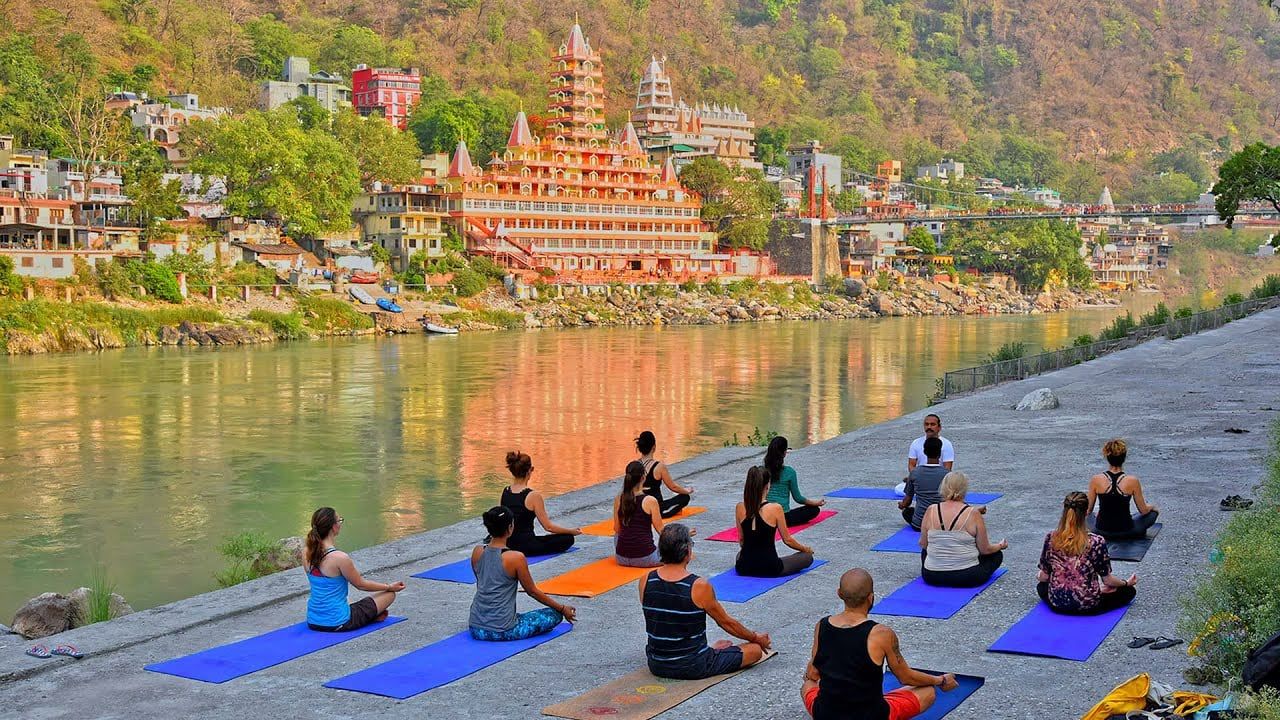
In Rishikesh, the town many people associate with yoga, the panchakarma program in the Himalayan foothills builds practice right into the daily schedule: gentle yoga for the joints and spine at 07:15, meditation or yoga nidra from 17:00 to 18:00, and consultations, treatments and rest in between. The schedule is approximate: the doctor sets the exact treatment times.
In the south, in Kerala, the same program runs by the ocean — Panchakarma in Varkala. And on the school’s courses the clinic day follows the Ayurvedic routine, so dinacharya is not just read about: what the training includes is described separately.
Sources
- Charaka Samhita, Sharira Sthana — section on the human being and the body: the subject of Ayurveda and the place of the word 'yoga' in it
- Charaka Samhita, Sutra Sthana — the aim of Ayurveda defined: to preserve the health of the healthy and to treat the sick
- Yoga Sutras of Patanjali — the eight limbs of practice and its aim
- Hatha Yoga Pradipika (Svatmarama) — the six cleansing actions of hatha yoga (shatkarma)
- Ashtanga Hridaya, Sutrasthana, chapter 2 'Dinacharya': the daily routine and the place of physical exercise in it (English summary, Easy Ayurveda)
- Vasant Lad. Textbook of Ayurveda, Vol. 1: Fundamental Principles — the three gunas as qualities of mind in Ayurveda
Frequently asked questions
Are Ayurveda and yoga the same thing?
No. They are two different systems from one tradition. Ayurveda's subject is health and disease; yoga's is working with the mind. They share a great deal — language, worldview, the idea of the three gunas — but their tools and goals are different.
Which came first, Ayurveda or yoga?
Neither has a precise answer: both bodies of texts took shape over a long time and through several redactions, and their datings differ by centuries. The classical texts give no grounds for saying that one system grew out of the other.
Should I practice yoga during an Ayurvedic program?
That is up to the doctor running the program. In our Rishikesh program gentle yoga and meditation are part of the daily schedule, but the doctor adjusts the amount and content of practice to the person's condition and the stage of treatment.
Are shatkarma in hatha yoga and panchakarma the same thing?
No, although they share one name — basti. Shatkarma are the six cleansing actions of hatha yoga; panchakarma are the five therapeutic procedures of Ayurveda, prescribed and supervised by a doctor. One cannot replace the other.
Are there asanas 'for vata', 'for pitta' and 'for kapha'?
The classical texts contain no such allocation. It comes from modern schools of Ayurvedic yoga therapy and is based on Ayurveda's general rule of opposite qualities. It is not a prescription and does not replace a doctor's advice.
Message us
We reply personally, tell you more and help you choose the program and dates. The message is pre-filled — just press Send.
We usually reply within a few hours.