
Treatments
Ayurvedic Treatments: Types and How They Differ
There are dozens of Ayurvedic treatments, each with its own purpose: some nourish the body with oil, some warm it, some focus on one area, some cleanse. We explain how the classical texts and Kerala practice group them, how the groups differ and which treatments are done only on a doctor's prescription.
What counts as an Ayurvedic treatment
Ayurvedic treatments are ways of working on the body described in the classical texts of Ayurveda and developed by modern practice: oil massage, pouring oil and decoctions over the body, sweating treatments, local oil “pools”, treatments for the head, eyes, ears and nose, and the cleansing procedures of panchakarma. They are performed with a therapist’s hands, with oil, herbs and heat. A single treatment on its own is not yet therapy: in Ayurveda it is placed in a plan built around the person.
You will see “Ayurvedic therapies”, “Ayurvedic procedures” and “Ayurvedic treatments” — they all mean the same thing. Below: how treatments are grouped and how the groups differ. Each well-known treatment has its own article on the site, linked as we go.
How the texts divide treatment
In the Ashtanga Hridaya treatment is divided into two broad kinds. The first lightens the body, the second nourishes it. Lightening, in turn, is of two sorts: shodhana — cleansing, when excess dosha is eliminated from the body — and shamana — pacification, when it is balanced without elimination, through diet, routine and remedies.
This gives a simple rule for treatments. Cleansing actions — vomiting, purgation, medicated enemas, nasal cleansing — belong to shodhana and form the core of panchakarma; it is shodhana that people loosely call an Ayurvedic detox, although it does not promise to “flush out toxins”. Almost everything else a person sees in a clinic — external oil, sweating, pouring treatments — works either as preparation for cleansing or as a gentle part of the plan in its own right.
So the same abhyanga can precede cleansing in one case and stand alone in the plan in another. What decides this is not the name of the treatment but the prescription.
Oil treatments: oil on the outside
The largest and best-known group. Ayurveda calls it external oleation: snehana is one of the two preparatory actions before cleansing, but external oil is also used quite apart from any panchakarma.
- Abhyanga — warm oil over the whole body in a set sequence, in several positions. The main type of Ayurvedic massage.
- Head, face and foot massage — the same principles applied to parts of the body. The Charaka Samhita counts oil on the head and feet as daily self-care.
- Pizhichil — the body is continuously bathed in warm oil while being gently massaged. A Kerala treatment performed by two or more therapists.
- Shirodhara — a thin stream of warm oil on the forehead. The same set-up is used with medicated buttermilk (takradhara) and with a sour grain decoction (dhanyamla dhara).
The oil is chosen for the person, not from a menu. How oils differ and how they are chosen is explained in the article on massage oils.
Sweating treatments: swedana
The second preparatory action is swedana, sudation or sweating. The Charaka Samhita devotes a separate chapter to it, listing sweating with fire — steam, hot poultices, pouring warm decoctions — and without fire, such as a warm room, the sun or physical exercise.
In a clinic three kinds are most common.
- Kizhi — hot bundles of leaves, powders or cooked rice are applied to the body with rhythmic movements. Several kinds are distinguished by their filling: leaves, powder, njavara rice.
- Steam box — the person sits or lies in a wooden cabinet with the head outside, and steam from a herbal decoction is directed at the body.
- Local steam — steam from a tube is directed at one spot, such as a joint.
Sweating follows oil rather than replacing it. The dry powder rub — udvartana — stands apart: there is no oil in it, and it is chosen when oil does not suit the person.
Local treatments: a basti on one area
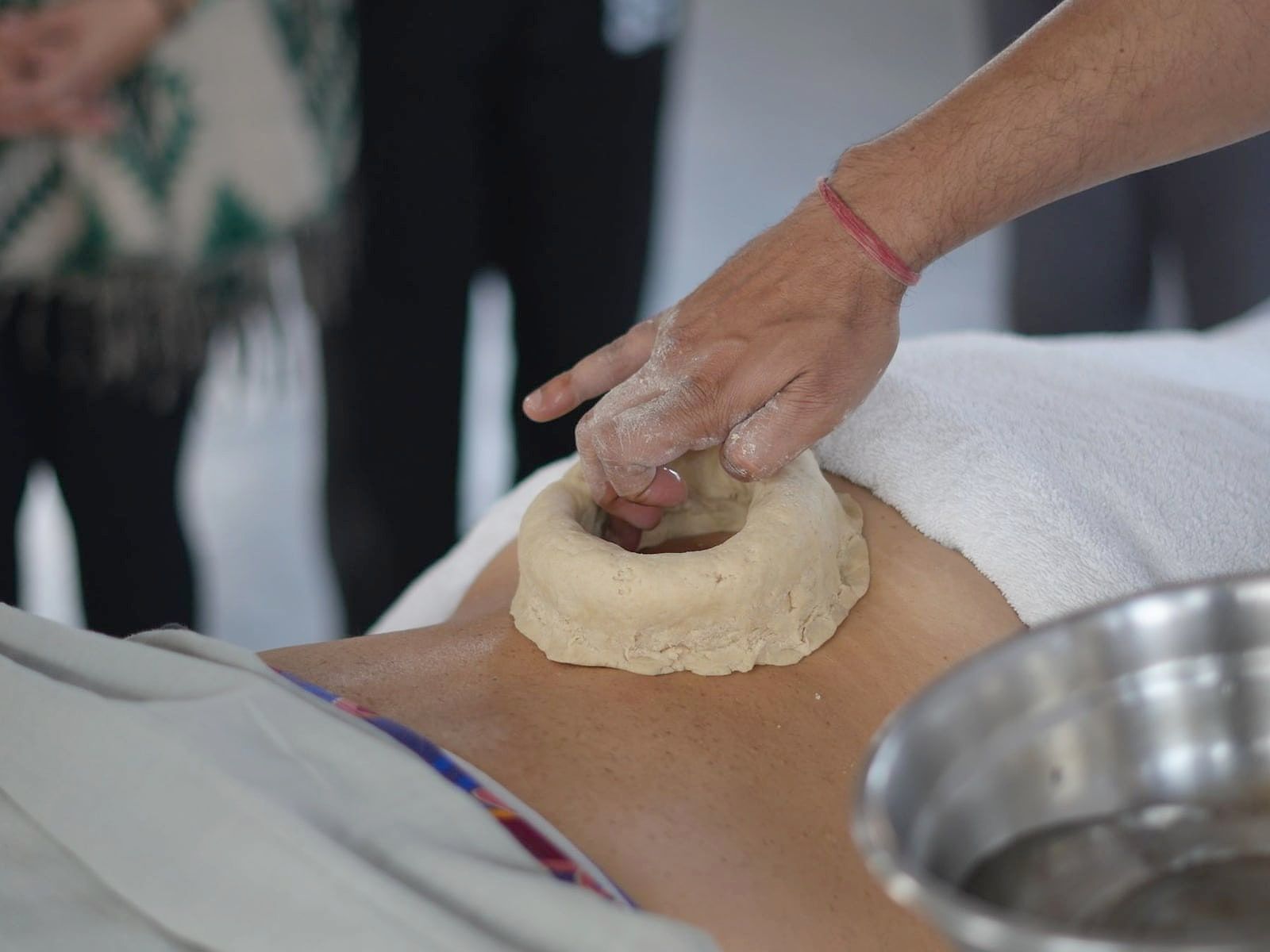
When one area needs work, warm oil is held on it in a “pool”. A ring or wall of dough is placed on the skin and filled with warm medicated oil. As the oil cools it is removed, rewarmed and poured back in, so the temperature holds throughout the treatment.
- Kati basti — on the lower back. That is what the photo for this article shows.
- Janu basti — on the knee.
- Greeva basti — on the neck.
- Uro basti — on the chest.
“Basti” here means “container”, not enema, although the word is the same. It is also spelled with a “v”: kati vasti. These treatments share only the name with the cleansing bastis of panchakarma.
This group grew out of a classical treatment for the head. The Ashtanga Hridaya lists four ways of applying oil to the head, in order of increasing strength: rubbing in; pouring — from which shirodhara developed; pichu, a cloth or cotton pad soaked in oil; and shirovasti, where oil is held on the head inside a tall, open-topped leather cap.
Treatments for the head, eyes, ears and mouth
A separate group is treatments for the sense organs. The Charaka Samhita places some of them in daily care and describes others as therapeutic.
- Oil pulling — oil is held in the mouth or swished between the teeth. The Ashtanga Hridaya distinguishes two techniques: holding the mouth full without moving the liquid, and swishing a small amount. More in the article on dinacharya.
- Oil in the ears — a few drops of warm oil; in a clinic this is karna purana, when the oil is held in the ear for a set time.
- Netra tarpana — walls of dough are placed around the eyes and filled with ghee; the person opens and closes their eyes in this “pool”. It is described in the Ashtanga Hridaya together with the related treatment putapaka.
- Nasya — oil or powder administered through the nose. The texts allow a few drops of oil as daily care, but strong nasya is one of the cleansing actions of panchakarma and is carried out by a doctor.
Even simple home techniques do not suit everyone. Nose drops and oil pulling are not given to children or to anyone who has difficulty controlling swallowing.
Cleansing: the procedures of panchakarma
Panchakarma — “five actions” — brings together the cleansing procedures: therapeutic vomiting, purgation, two kinds of medicated enema, nasal cleansing and, in some lists, bloodletting. It is a doctor-led program in three stages: preparation with oil and heat, the main procedure and a gradual return to normal food.
It is prescribed and supervised by an Ayurvedic doctor after an examination. Without a doctor it is not panchakarma but a set of pleasant treatments. Each cleansing action has its own long list of people it does not suit — the essentials are gathered in Who panchakarma suits and who should avoid it.
How a treatment is chosen
In Ayurveda a treatment is chosen not from a price list but for the person. The doctor looks at prakriti — the inborn constitution — and the current state, digestion, age, strength and the season. These determine the oil, temperature, pressure, duration and order of treatments.
Hence a few signs that distinguish a genuine Ayurvedic treatment from a treatment with an Ayurvedic name:
- before the treatment you are asked how you feel and about contraindications;
- the oil is chosen, not one for everyone;
- treatments come as a course and in a set order, not singly and at random;
- cleansing procedures are not offered without a doctor.
External treatments — oil and sweating — also translate to the spa on the same condition: the therapist is trained and knows when a treatment must not be done. What can and cannot go on a spa menu is covered in Ayurvedic treatments in the spa.
Where to learn this
Each treatment is a separate skill: knowing the names is one thing, setting up a shirodhara or kati basti with your own hands and knowing when it must not be done is another. On the school’s one-month course students work week by week through abhyanga and shirodhara, sweating treatments and dharas, the Kerala treatments — kizhi, pizhichil, udvartana — treatments for the eyes, ears and nose and local bastis, while the theory of cleansing procedures is studied together with their contraindications.
Sources
- Ashtanga Hridaya (Vagbhata), Sutra Sthana, chapter 14 — the two kinds of treatment: lightening (with cleansing and pacification) and nourishing
- Ashtanga Hridaya (Vagbhata), Sutra Sthana, chapter 22 — mouth gargles and the four ways of applying oil to the head: abhyanga, pouring, pichu, vasti
- Ashtanga Hridaya (Vagbhata), Sutra Sthana, chapter 24 — tarpana and putapaka, treatments for the eyes
- Charaka Samhita, Sutra Sthana, chapter 5 — daily care: oil in the nose, oil pulling, oil on the head, ears and feet
- Charaka Samhita, Sutra Sthana, chapters 13 and 14 — oleation (snehana) and sudation (swedana): types and rules
- Charaka Samhita, Siddhi Sthana — the five cleansing procedures and how they are carried out
Frequently asked questions
What are the best-known Ayurvedic treatments?
Abhyanga — full-body oil massage; shirodhara — a stream of warm oil on the forehead; pizhichil — pouring oil over the body; kizhi — warming with herbal poultices; udvartana — a powder rub. All of these are external. The cleansing procedures of panchakarma are known by name, but they are performed only on a doctor's prescription.
How is an Ayurvedic treatment different from a spa treatment?
In how it is chosen and why. An Ayurvedic treatment is chosen for the person's constitution and current state, with questions about contraindications, and usually as a course. A spa treatment is designed for relaxation and is the same for everyone. External Ayurvedic treatments can be done in a spa if the therapist is trained and respects the contraindications.
What is kati basti?
A local treatment for the lower back: a ring of dough is placed on the skin and filled with warm medicated oil, which is held there for a set time and kept warm. Janu basti on the knee, greeva basti on the neck and uro basti on the chest work the same way. It is also spelled kati vasti.
Can I do Ayurvedic treatments at home?
The classical texts count some of them as daily self-care: oil on the body, head and feet, and oil pulling. The rest — local bastis, shirodhara, pizhichil, cleansing procedures — are performed by trained therapists, and cleansing only on a doctor's prescription and under supervision. Even a simple oil massage has contraindications.
How many treatments are needed in a course?
There is no single number. Ayurveda works with a series of treatments, but which ones, how many and in what order is decided by the doctor according to the person's condition and the season.
Message us
We reply personally, tell you more and help you choose the program and dates. The message is pre-filled — just press Send.
We usually reply within a few hours.