
Ayurvedic kitchen
Ghee: What It Is and How to Make It at Home
Ghee is butter cooked until its water evaporates and the milk solids settle and turn golden. We explain how ghee differs from ordinary clarified butter, how to make it at home in half an hour, how to store it, and what place it holds in Ayurveda — without exaggerating its benefits.
What is ghee
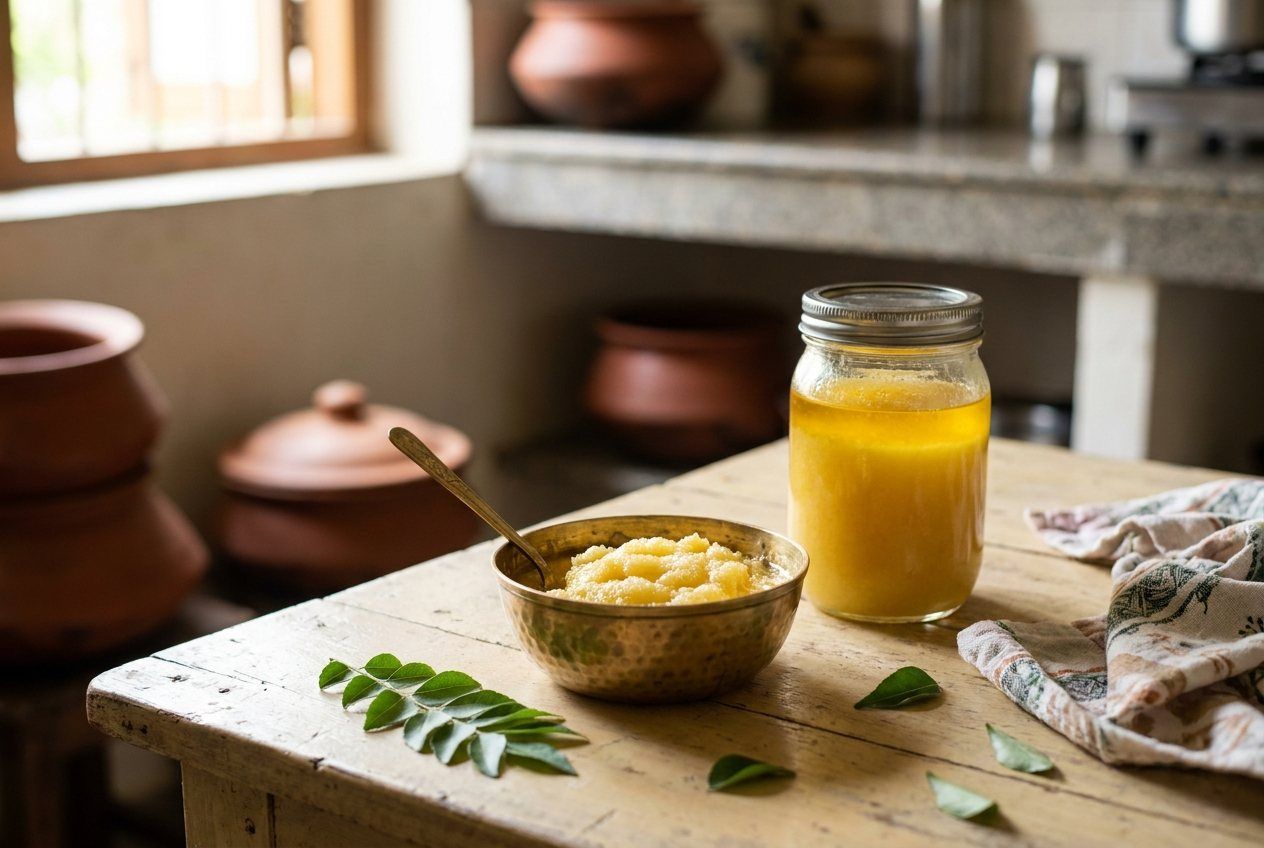
Ghee is butter that is slowly rendered over low heat. Its water evaporates, the milk proteins coagulate and sink to the bottom, and clear golden fat remains on top. This is strained — and the result is ghee: a fat with a gentle nutty aroma that sets into a grainy, cream-colored mass.
In India ghee is an everyday cooking fat, much as olive oil or butter is in the West. Spices are fried in it, it is stirred into rice and dal, and spread on flatbreads. In Ayurveda ghee is one of the most important substances of all: it is eaten, medicines are prepared with it, and it is used in treatments.
The word comes from the Sanskrit “ghrita”, which is also the name you will see on Ayurvedic medicated ghees.
How ghee differs from butter and clarified butter
Butter is not just fat. Ordinary butter contains around 16–18% water; the rest is milk protein, the milk sugar lactose and salts. It is the water and protein that make butter awkward to fry with: it foams, spits and burns quickly.
Ghee contains almost no water or protein. According to the USDA food composition database, 100 g of ghee contains over 99 g of fat and less than 0.3 g of protein. Hence its properties in the kitchen:
- It doesn’t burn as quickly. You can fry spices and vegetables in ghee at high heat without black residue and bitterness.
- It keeps longer. Without water, spoilage proceeds more slowly, so ghee doesn’t need refrigerating for the first few weeks.
- A different flavor. The browned milk solids at the final stage give a nutty, slightly caramel aroma.
Clarified butter, familiar from French cooking, shares the same idea with ghee: it is also rendered milk fat. The difference is the degree of heating. Clarified butter is often heated gently and taken off once the water has gone and the solids have been skimmed. Ghee stays on the heat a little longer — until the sediment at the bottom turns golden brown. That is why its flavor is richer. If you have bought good clarified butter, in the kitchen it will behave almost the same as ghee.
How to make ghee at home
Making ghee at home is not difficult; it only takes time and attention. The main thing is not to walk away from the stove in the last few minutes.
What you need:
- Butter. Unsalted, with no vegetable fats added. The better the butter, the tastier the ghee. 500 g of butter yields roughly 400 g of ghee.
- A heavy-bottomed pan. In a thin pan the sediment will burn before the ghee is ready.
- Cheesecloth or a fine sieve and a clean, dry glass jar with a lid.
How to make it:
- Step 1. Melt the butter. Cut it into cubes, put it in the pan and melt over low heat. Don’t cover it: the water needs to evaporate.
- Step 2. Wait for it to simmer and foam. The butter will start to simmer quietly and white foam will gather on top. You can skim it off with a spoon or leave it — it will settle or be strained out anyway.
- Step 3. Keep it on low heat. The butter will crackle: that is the water boiling off. Don’t stir and don’t turn up the heat. This stage usually takes 15–30 minutes, depending on the amount of butter and your stove.
- Step 4. Watch for the signs it is ready. The crackling dies down, the bubbles become small, the butter turns clear and golden, and the sediment at the bottom is light brown. The kitchen smells of cookies or nuts. At this point take the pan off the heat.
- Step 5. Cool and strain. Let it stand for 5–10 minutes and strain through several layers of cheesecloth into a dry jar. Don’t pour the sediment into the jar: it will make the ghee spoil faster.
If the sediment has turned black and the smell has become bitter, the butter has overheated. Such ghee tastes bitter, and it is better to start again on lower heat.
Hot ghee is clear; cooled, it is thick and pale, often with a grainy texture. This is normal and does not affect quality.
How to store ghee
Ghee keeps longer than butter, but not forever. Its fat oxidizes over time, and this is the main cause of ghee spoilage.
- A clean, dry jar. Water speeds up spoilage: even a drop from a wet spoon shortens its life.
- A dry spoon. Scoop ghee only with a clean, dry spoon, not a knife you’ve just used on bread.
- Dark and cool. In a cupboard out of the sun ghee usually keeps for several weeks, in the fridge for several months.
- Check the smell. Good ghee smells of cream and nuts. A bitter, sharp or “soapy” smell is a sign of rancidity; throw such ghee away.
Ghee in Ayurveda
Ghee holds a special place in the classical texts of Ayurveda. The Charaka Samhita, in its chapter on fats, lists four main ones — ghee, plant oil, animal fat and bone marrow — and calls ghee the best of them. In the chapter on food, according to the text, cow’s ghee is sweet in taste and cooling in action, calms vata and pitta, and supports digestion, memory and strength. The Ashtanga Hridaya says ghee is suitable for people of any age.
That is why ghee turns up everywhere in Ayurveda.
- In food. A little ghee, according to Charaka, aids digestion: food should not be completely dry. In Ayurvedic cooking ghee is used to fry spices for dal and kitchari, and is added to rice and sweets. More on the rules of eating in The Ayurvedic diet.
- Before panchakarma. At the preparation stage the doctor prescribes ghee or a medicated oil on an empty stomach in gradually increasing doses. This is a medical procedure: the dose is set each day according to how the person feels. How it works is explained in Preparing for panchakarma.
- As a base for medicines. Ghee is cooked with herbs just as oils are, producing medicated ghritas. These are prescribed by a doctor.
- In treatments. Ghee is rarely used for full-body massage, but in some treatments, for the eyes for example, it is used on prescription. On massage oils, see Oils for Ayurvedic massage.
By tradition, ghee is especially suitable when pitta and vata predominate. With kapha — a heavy, slow state — less is used. What these doshas are is explained in The three doshas: vata, pitta, kapha.
How to use ghee in the kitchen
Ghee is handy wherever butter burns but you want to keep the creamy flavor.
- Tempering spices. In Indian cooking this is called tadka: cumin, mustard seeds, turmeric and asafoetida are fried in hot ghee for a few seconds, then poured over dal or soup.
- Grains and porridge. A spoonful of ghee in rice, oatmeal or any grain is the simplest way to try it.
- Frying and roasting. Vegetables, omelets, pancakes, flatbreads.
- Baking and sweets. Ghee can replace butter in dough, but remember that it contains no water, so the dough may come out drier.
A serving is usually a teaspoon, occasionally a tablespoon. You don’t need more: ghee has a rich flavor.
Benefits and calories
Ghee is often described as a superfood. A sober view: it is a milk fat, tasty and convenient, with a long history in traditional medicine. But it is still almost pure fat.
- Calories. According to the USDA, 100 g of ghee contains about 876 kcal. A teaspoon, about 5 g, is roughly 45 kcal; a tablespoon, about 13 g, roughly 115 kcal.
- Saturated fat. About 62 g per 100 g — more than in butter, because ghee contains no water. The WHO advises that saturated fat make up less than 10% of total energy intake. On a 2,000 kcal diet that is about 22 g a day — roughly two tablespoons of ghee if there are no other sources.
- Cholesterol. Ghee contains cholesterol, like any milk fat.
- Vitamins. Ghee contains fat-soluble vitamins, vitamin A above all, but there is no need to eat it for the vitamins: the servings are too small.
The practical conclusion: use ghee instead of butter, not in addition to it. If you have high cholesterol, heart, liver or gallbladder disease, or your doctor has restricted fats, discuss the amount of ghee with them. Taking ghee by the spoonful on an empty stomach is an Ayurvedic therapeutic procedure; it is done only on a doctor’s prescription, not for a “cleanse” at home.
Sources
- Charaka Samhita, Sutra Sthana, chapter 13 'Sneha': the four kinds of fats, ghee the best of them (Charak Samhita Online)
- Charaka Samhita, Sutra Sthana, chapter 27 'Annapanavidhi': properties of cow's ghee (English summary, Easy Ayurveda)
- Easy Ayurveda. Ghee Benefits, Usage, Side Effects, Contra Indications — ghee in the Ashtanga Hridaya and Bhavaprakasha
- USDA FoodData Central — Butter oil, anhydrous (anhydrous milk fat, ghee): nutrition per 100 g
- WHO. Healthy diet: fact sheet (saturated fats under 10% of energy intake)
Frequently asked questions
What is ghee in simple terms?
It is butter with the water cooked off and the milk solids removed. What remains is pure golden milk fat with a nutty aroma. In India ghee is an everyday cooking fat and one of the key substances of Ayurveda.
How is ghee different from clarified butter?
They are close relatives: both are rendered milk fat. Ghee is kept on the heat longer, until the milk solids lightly brown, so it has a more pronounced nutty flavor and aroma. Ordinary clarified butter is often heated more gently and taken off earlier.
How do I make ghee at home?
Take good unsalted butter, melt it in a heavy-bottomed pan and keep it on low heat for 20–40 minutes, until the butter turns clear and the sediment at the bottom is golden brown. Then strain through cheesecloth into a dry jar.
How long does ghee keep?
In a clean, dry jar with a lid, in a cool dark place — several weeks; in the fridge — several months. The main thing is to keep water out of the jar: always use a dry spoon. If it develops a bitter or rancid smell, throw it away.
Can I eat ghee if I'm lactose intolerant?
Ghee contains only traces of lactose, and many people with lactose intolerance tolerate it well. If you are allergic to cow's milk protein, don't use ghee without a doctor's advice: it may contain traces of protein too.
Message us
We reply personally, tell you more and help you choose the program and dates. The message is pre-filled — just press Send.
We usually reply within a few hours.